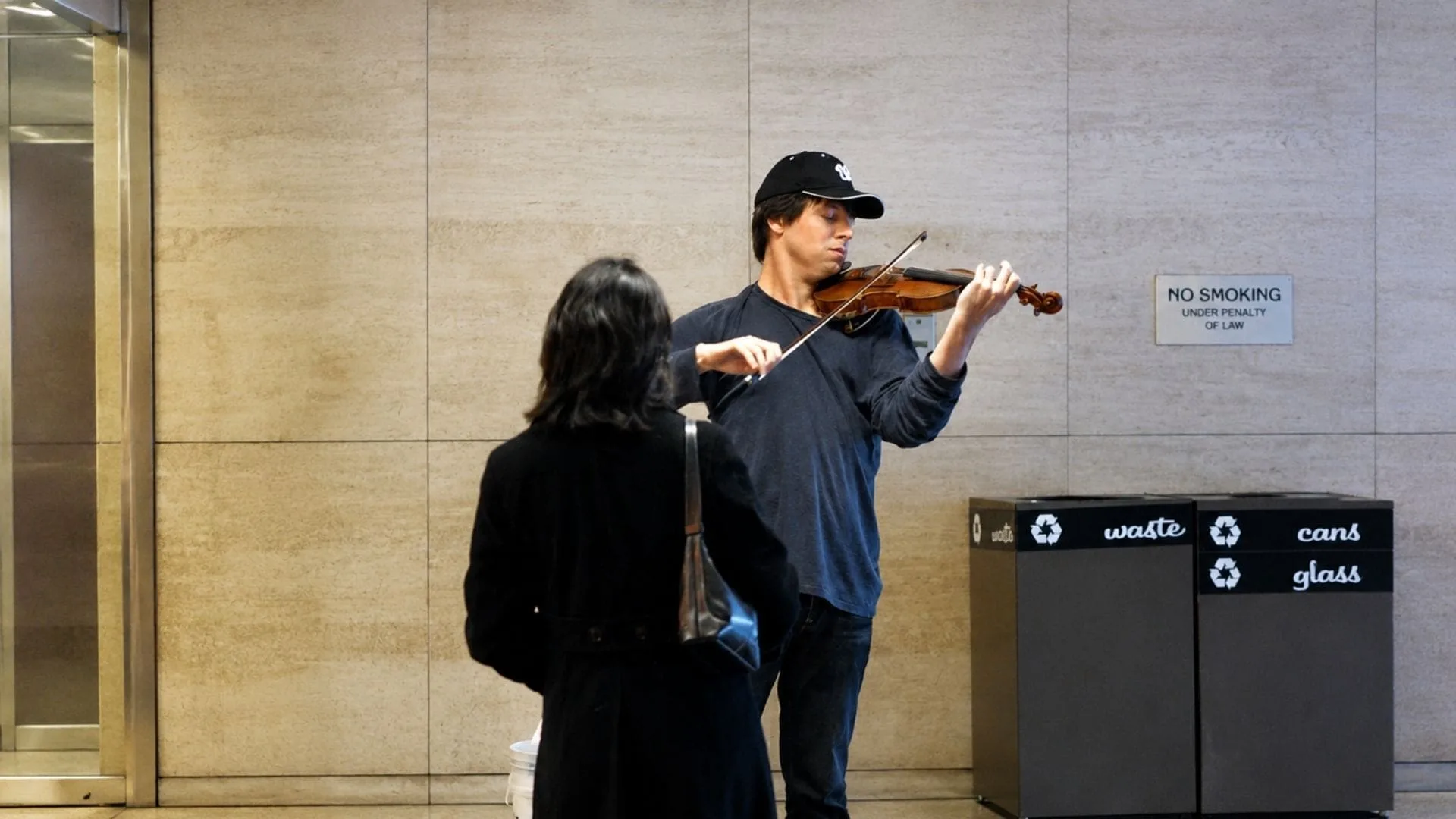
On a cold morning in Washington, D.C., during the rush hour of an ordinary workday, a man stood at the entrance to the L’Enfant Plaza Metro station, took out his violin, and began to play. Around him, people hurried past with coffee cups in their hands, bags over their shoulders, and the short, quick steps of an urban morning.
The man playing was not an anonymous street musician. It was Joshua Bell, one of the most celebrated and admired violinists in the world. A former child prodigy, he had performed with leading orchestras, won prestigious awards, and filled concert halls where audiences sit in almost ceremonial silence. Just three days earlier, Bell had performed at Boston’s Symphony Hall, where even ordinary seats cost around $100. But that morning, dressed simply and playing like a busker in a subway station, almost no one stopped to listen.
For 43 minutes, he played six classical pieces. During that time, 1,097 people passed by. Only a handful truly paused to listen. A few dropped coins or bills into his violin case, most of them without breaking their stride. In total, he collected a little over $30. Almost none of the passersby knew that they were walking past one of the greatest violinists in the world, playing on an exceptionally rare Stradivarius violin valued at approximately $3.5 million.
The obvious question is: how is this possible? How could people fail to recognize such quality? How could beauty of this magnitude pass so close to them, while they simply kept walking?
But perhaps that is not the most precise question.
The people who passed by were not sitting in a concert hall, listening to Joshua Bell, and deciding that his playing was “not that impressive”. They were inside a completely different story. They were on their way to work. They were inside a schedule. They were inside the mindset of the morning: getting there on time, catching a train, preparing for meetings, thinking about children, fatigue, errands, responsibilities. And inside that story, a person playing music in a Metro station is usually just another street musician.
In other words, they did not see only the person playing. They did not hear only the music. They perceived all of it through context.
We Don’t Just See Reality. We See a Story
The Joshua Bell experiment reveals something essential about the human mind: we do not encounter reality in a pure, untouched form. We meet it through frameworks, expectations, labels, contexts, and stories that already live within us.
It was the same violin, the same musician, and the same music. But when he plays in a concert hall, especially after we have paid for a ticket, the mind tells us: “Something important is happening here. Pay attention”. When, on the other hand, the same musician plays in a subway station, the mind tells us: “Just another street performer”. Apparently, we do not simply absorb reality as it is. We are interpreting it all the time.
One of the people who studied this mechanism deeply was neuroscientist Michael Gazzaniga. He called this part of the brain “the interpreter”.
Michael Gazzaniga arrived at the idea of the interpreter in a fascinating way. He studied people who had undergone surgery to disconnect the two hemispheres of the brain. This operation, performed in the past in severe cases of epilepsy, essentially severs the corpus callosum – the bundle of nerve fibers that allows the two hemispheres to communicate with one another.
From the outside, these people seemed completely ordinary. They spoke, walked, thought, and functioned. But in laboratory experiments, something remarkable emerged: sometimes one side of the brain knew something the other side did not.
In one of the most famous experiments, a participant was shown two different images at the same time. The left hemisphere, which is usually associated with speech and language, saw a chicken claw. The right hemisphere saw an image of snow. The participant was then asked to choose matching pictures from several options. The right hand, connected to the left hemisphere, chose a chicken. The left hand, connected to the right hemisphere, chose a shovel. So far, everything made sense: a chicken fits a claw, and a shovel fits snow.
But then came the truly interesting part.
When the participant was asked why he had chosen the shovel, the left hemisphere – the speaking hemisphere – did not know that the choice had been made because of the image of snow. It had not seen the snow. And yet, it provided an explanation: the shovel was needed to clean the chicken coop. The explanation was wrong, of course, but it was convincing. It even sounded logical, because it created a coherent story.
This experiment led Gazzaniga to investigate the strange phenomenon he later called “the interpreter” – an inner mechanism, associated mainly with the left hemisphere of the human brain, that constantly tries to explain what is happening. It takes actions, sensations, impulses, emotions, and fragments of information, and arranges them into a single story. It is not necessarily the true story, nor the whole story, but it gives us a sense of logic, control, and continuity. It lets us feel: “I know why I did what I did”.
The Interpreter as the Lens of Reality
The interpreter is like an inner pair of glasses through which we see reality. We do not usually notice that we are wearing them, because we have become so accustomed to their presence. These glasses do not only explain reality after it happens. In many cases, they determine in advance what we will recognize, what we will pay attention to, and what will disappear beneath our radar.
When Joshua Bell plays in a concert hall, our interpreter is tuned to words like “beauty”, “art”, “value”, and “deep listening”. When the very same person plays in a Metro station, the interpreter changes the story to: “street”, “noise”, “someone asking for money”, “I don’t have time”. The ear may hear the music, but the inner story has already conditioned the experience.
And this does not happen only with music. It happens almost everywhere in life.
We meet a new person, and we have already begun telling ourselves who they are. We feel tension in the body, and immediately we explain to ourselves why. Someone does not reply to a message, and the interpreter rushes to build an entire story around it. Sometimes the story is true. Sometimes it is almost true. And sometimes it is light-years away from what actually happened.
Interestingly, several years later, something like a mirror image of the original experiment took place. In 2014, Bell returned to play near a Metro station in Washington, D.C., but this time the event was announced in advance. The result was completely different: several hundred people came specifically to hear him, gathered around, and listened with full attention.
The problem, then, is not the interpreter itself. Without it, life would be extremely difficult. The interpreter helps us understand, choose, remember, connect events, and create a sense of identity and continuity. The problem begins when we forget that it exists, when we confuse interpretation with reality itself, and when we fail to remember that this mechanism, like every human mechanism, can also be mistaken.
The Joshua Bell experiment reminds us that sometimes beauty is already there, right before our eyes, but the story we are inside does not allow us to see it.
And so the real question becomes: how many things do we miss each day simply because of the story our inner interpreter tells us about reality? How many opportunities pass beside us because we have already decided what they are worth? How many people do we judge too quickly, before we have truly listened? How many moments of beauty, possibility, or grace are lost simply because the mind has already marked them as unimportant?
The deeper invitation of this story is not to silence the interpreter, but to learn to see it. To notice the moment when it rushes to explain, label, and close the experience inside a familiar frame.
Because sometimes, right next to us, within the ordinary noise of the day, something rare is already playing.
And the choice is ours: whether to keep walking, or to pause for a moment and listen.

