One morning, at the age of thirty-seven, Dr. Jill Bolte Taylor woke up with a sharp pain behind her left eye. It was not an ordinary headache, nor a passing sensation she could simply ignore. Something within her knew that something serious was happening, but it took time for her to understand just how profoundly that morning would change her life.
Bolte Taylor knew the human brain intimately. She was a brain scientist who had devoted her life to researching mental illness and exploring how different structures within the brain shape our experience of reality. But on that December morning in 1996, the brain she had spent years studying suddenly became her most personal field of research.
A blood vessel had ruptured in the left hemisphere of her brain. Over the course of several hours, she experienced a severe stroke. As she gradually lost the ability to speak, read, understand numbers, remember her own life, and move her body normally, she was also observing everything that was happening to her. As a brain scientist inside her own neurological event, she became a living witness to the gradual disintegration of the mechanisms that form our sense of “I”.
When the Inner Voice Falls Silent
The left hemisphere of the brain loves order. It breaks the world into details, gives names to things, connects past and future, plans, compares, measures, and constantly tells us who we are. It is also the voice inside us that says: “I need to remember”, “I have to get this done”, “I am this kind of person”, “I am not that kind of person”, “This is my story”…
During the stroke, that inner voice of Jill Bolte Taylor began to disappear. The language centers in her brain were damaged, and the inner speech that held together her everyday identity fell silent. At times, she could no longer think in words. She could not read the numbers on her business card, could not understand the telephone, and could not form a clear sentence to ask for help.
But alongside that loss, another experience began to emerge. As her left hemisphere fell silent, a completely different mode of perception opened within her. She describes how the boundaries of her body began to dissolve. She looked at her hand and could no longer distinguish where it ended and where the wall beside it began. Instead of a separate body, instead of a woman with a name, a profession, a past, and plans, she experienced herself as an inseparable part of a vast field of life.
The Right Hemisphere and the Experience of the Moment
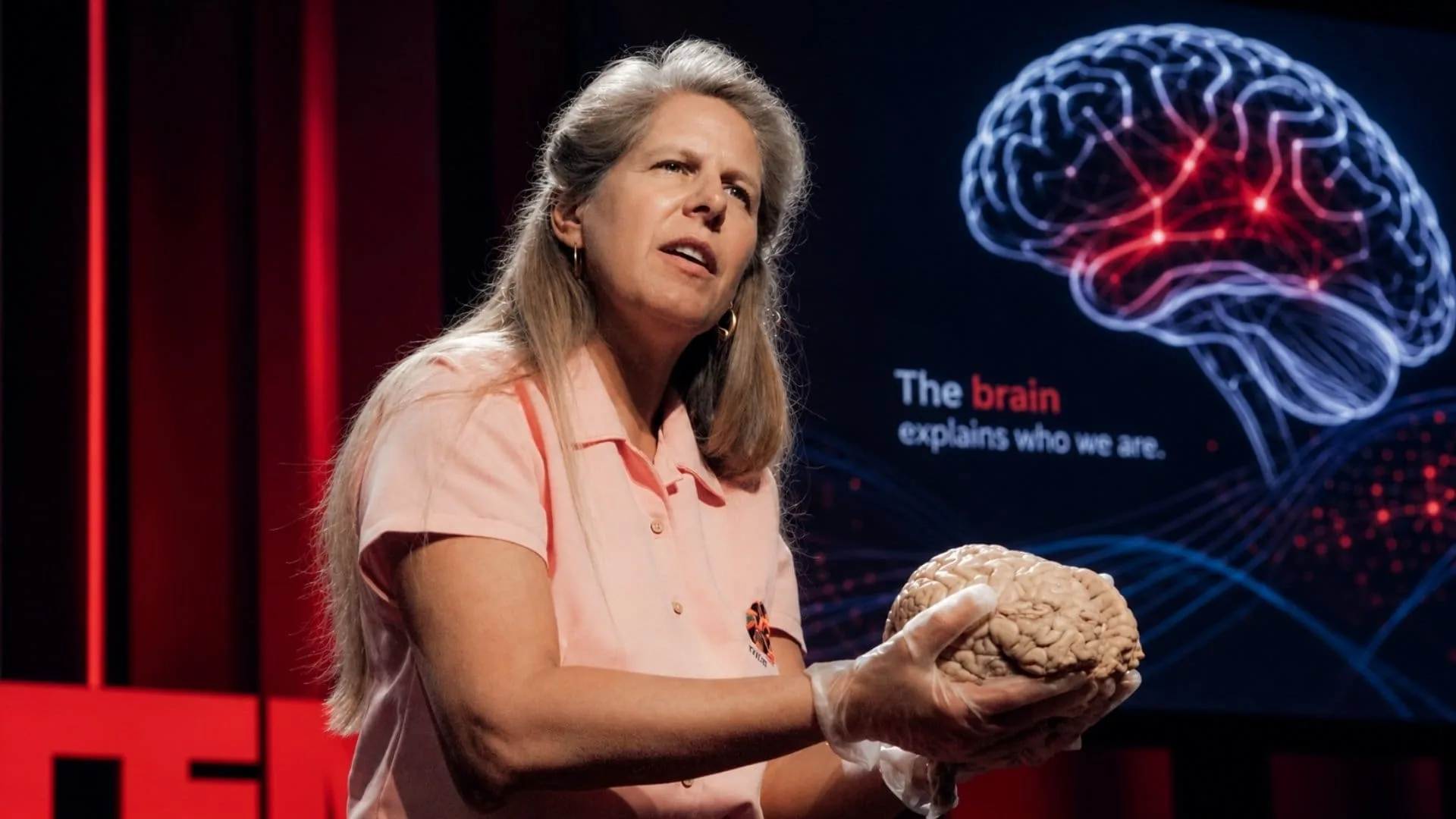
In her famous TED Talk, Jill Bolte Taylor describes the difference between the two hemispheres of the brain through the lens of her own lived experience. The left hemisphere is where reality is interpreted. The right hemisphere, as she describes it, lives entirely in the present. It receives the moment through images, sensations, movement, sounds, smells, and touch. It does not rush to separate, nor does it need to immediately give everything a name.
Her story teaches us not only about stroke or the functioning of the brain. It gently unsettles our confidence that the way we perceive ourselves is the only possible way. What we call “I” rests upon very specific neural systems. When those systems change, our experience of reality changes as well.
Jill Bolte Taylor’s talk opens a rare doorway into a conversation between neuroscience, consciousness, meditation, and presence. She does not dismiss thought, language, or reason. She knows very well how essential they are. Without them, she could not have returned to life, relearned what she had lost, recovered, spoken, written, and shared her story. But she reminds us that there are other ways to experience reality. Beneath the noise of thought, beneath the constant effort to define ourselves, there is another layer of being.
Eight Years of Returning to Life
After the stroke, Bolte Taylor underwent complex brain surgery, followed by a long rehabilitation process that lasted eight years. She had to relearn basic things such as walking, speaking, reading, understanding sequences, and recognizing objects. But this return was not simply a return to what had been. Something in her had changed.
She did not want to completely give up the quality that had been revealed to her when her left hemisphere fell silent. During her recovery, she sought to preserve her contact with the right hemisphere: with empathy, peace, creativity, a sense of connection, and the ability to be present in the moment without immediately contracting into worry or definition.
Her inner testimony is perhaps the reason her talk became one of the most memorable TED Talks ever given. Jill Bolte Taylor returned from her stroke with a story that reminds us that we are not only our inner speech. Not only our memories, roles, plans, and fears. Human consciousness is far wider, and far more wondrous, than we usually imagine.